
Sierra Delta Case Study
Sierra Delta is a nonprofit community providing grants for veterans to train their dogs as a Life Buddy. It has always been a special organization built on key elements of a long-lasting successful community: a super clear vision for the world, members who can’t wait to lead, proven transformation examples, and the ultimate community cheat code: dogs.
When we first partnered with BJ Ganem at Sierra Delta, the organization was at a crucial moment.
After downsizing from a large staff when funding slowed, much of the day-to-day operational responsibility was falling on one person. Community support, grant operations, communication, and long-term growth were all being managed simultaneously, often with limited capacity.
BJ was so overwhelmed that he had considered shutting down the organization.
Community members were feeling the rough patch. Emails were going unanswered, community information was outdated, the grant process was hard to figure out, and members started to engage only when participation was mandatory.
The issue wasn’t that they weren’t interested in participating, but that growth had outpaced the community’s capacity and infrastructure and everything was breaking.
The structural issues became obvious when they no longer had a large staff to support everyone individually.
From Staff-Led Support to Distributed Leadership
We joined as an embedded operational and community partner. From the start, the goal wasn’t just to fill the gaps the full-time team had left, but to redesign how the community functioned so that the organization could stay lean long term without a large staff.
As a scrappy nonprofit, endless operational expansion wasn’t realistic or aligned with their mission. What they needed were scalable systems that enabled the community to function well and members to support one another directly.
We built a strategy that focused on:
Creating a clearer member experience.
Reducing operational friction.
Developing leadership pathways for members.
Transitioning towards repeatable community seasons that are easier to support.
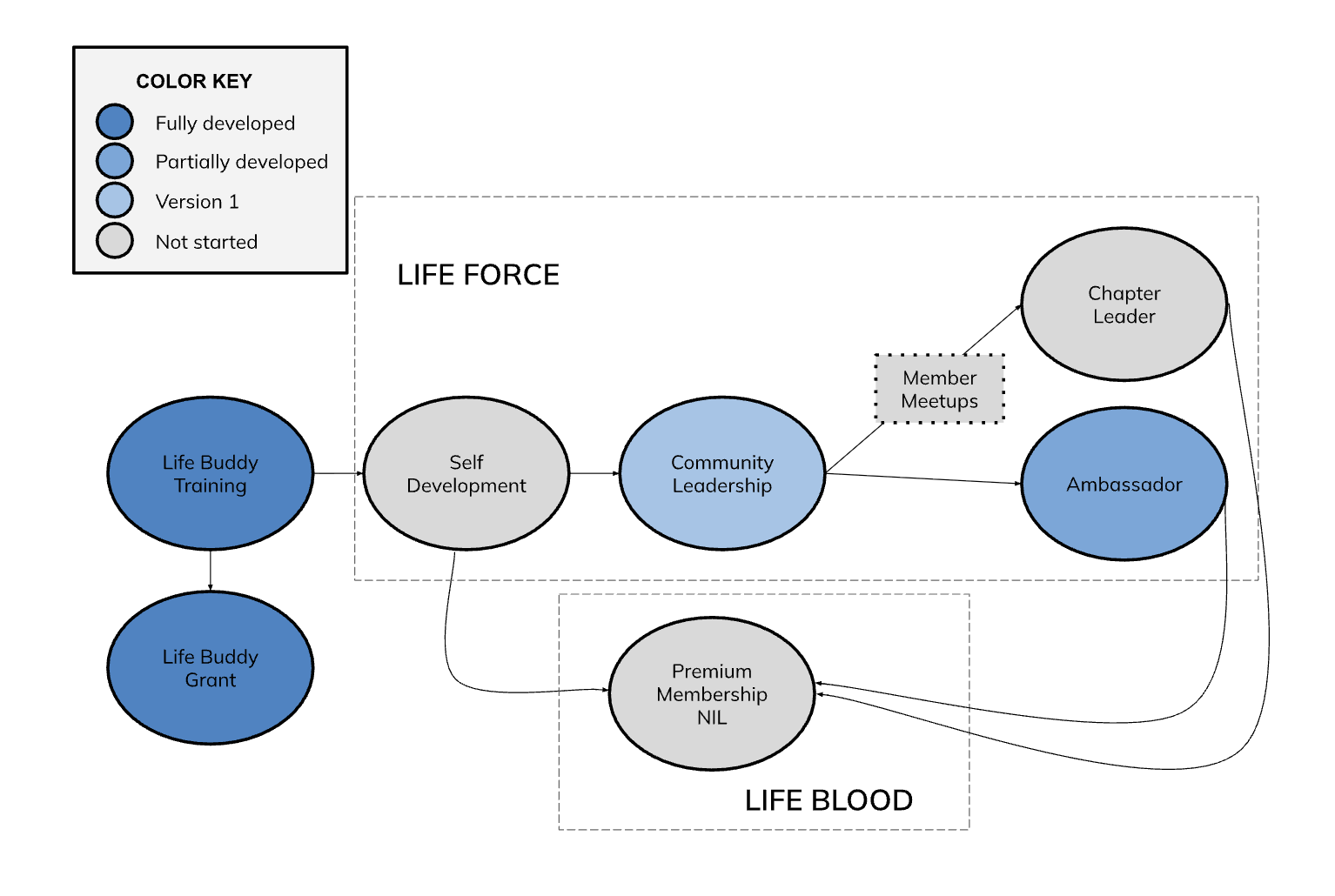
This was our initial sketch of the long term member experience.
1. The Initial Implementation: Stabilizing Operations
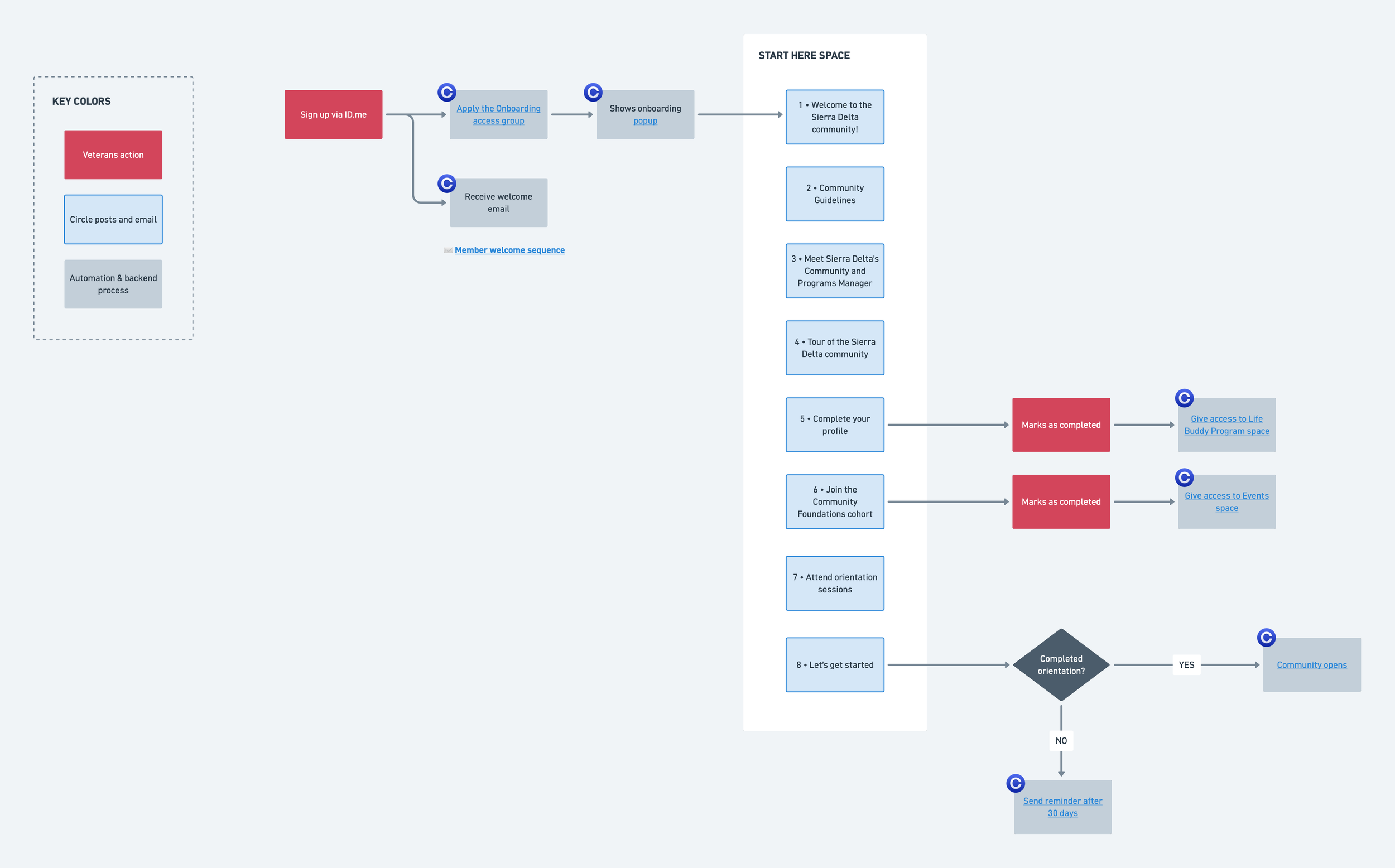
Onboarding + Communication
There was a lot of friction in member onboarding that would cause confusion and generate endless customer service messages for the team.
We designed an experience that helped members have a smooth first experience, learn how things worked logistically, and intuitively start participating in the community.
Grant Operations
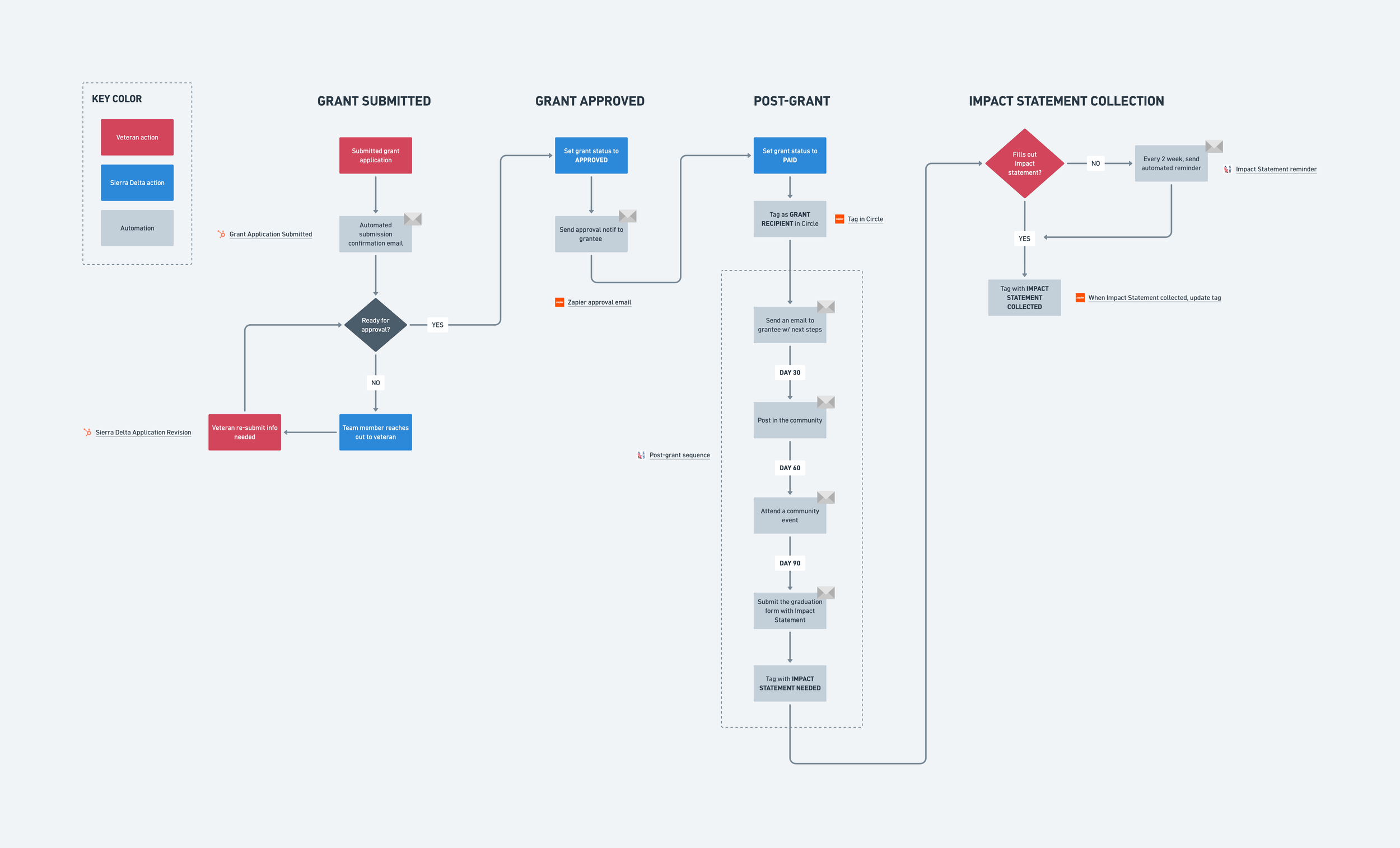
When Sierra Delta members first join the community, they’re invited to apply to get a dog training grant. The organization approaches this differently in that the dog doesn’t have to be a certified service dog and that member-participation in the training decisions are crucial to the process.
The grant application had to educate members on dog training and empower them to take initiative and build a plan that would work for them and their dog.
But this wasn’t working. Instead of empowering members, the process was making them dependent on the team for support.
So we rebuilt the grant application experience to accomplish 2 goals:
Remove friction from the tech side so that the process worked smoothly.
Find the balance between a process that was clear and well-communicated, but gave members agency to find their own path with less hand-holding.
Internal Systems
Different iterations of the community over the years meant that there was a lot to align under one process operationally.
So we:
Temporarily took over any manual ops tasks like posting recordings, answering questions, and scheduling reminders.
Organized fragmented workflows.
Improved operational consistency through documentation of processes as we built them.
As we finalized the initial implementation, the community was already requiring a lot less of the team. Internal trust and operational stability improved.
2. Designing a Community That Could Scale Through People
Once the core community programs were stable, we started working on what would fully unlock the mission of Sierra Delta: scaling member leadership.
Agency was already a core value of the community, which meant many members were ready to find ways to lead.
We started working on architecting opportunities for member leadership.
Peer Leaders
The vision for Sierra Delta was inspired by infinitely scalable, peer-led community structures like Alcoholics Anonymous.
We wanted members to have a path to continue participating and leading beyond the initial value of the community.
So we designed a program for peer leaders to be trained in a role that helped the community and allowed them to stay engaged for years to come.
Each quarter we now open up the program to new leaders and expand and improve the program. Volunteer leaders have allowed members to feel supported without hiring case managers like in a traditional nonprofit services organization.
Member Meetups
Our Member Meetups initiative was created to provide a safe and engaging way for the community to connect in person. Over the first few weeks, dozens of members successfully met face-to-face, building stronger relationships locally.
These gatherings were carefully organized to prioritize safety and comfort, ensuring that everyone could participate with confidence. And that members who were ready could step up to lead as a host.
We plan to scale up this program to enable many more small group gatherings in the second year.
Cohort Design
To emphasize leadership development and initiate training for member leaders as soon as they join, we transitioned the grant process to a cohort structure.
We designed an intensive four-week program to equip members with what they need to secure grants as well as integrate them deeply into the organization. Participants emerge with a clearer understanding of the grant process and a stronger sense of leadership, ultimately contributing to the community’s growth and success.
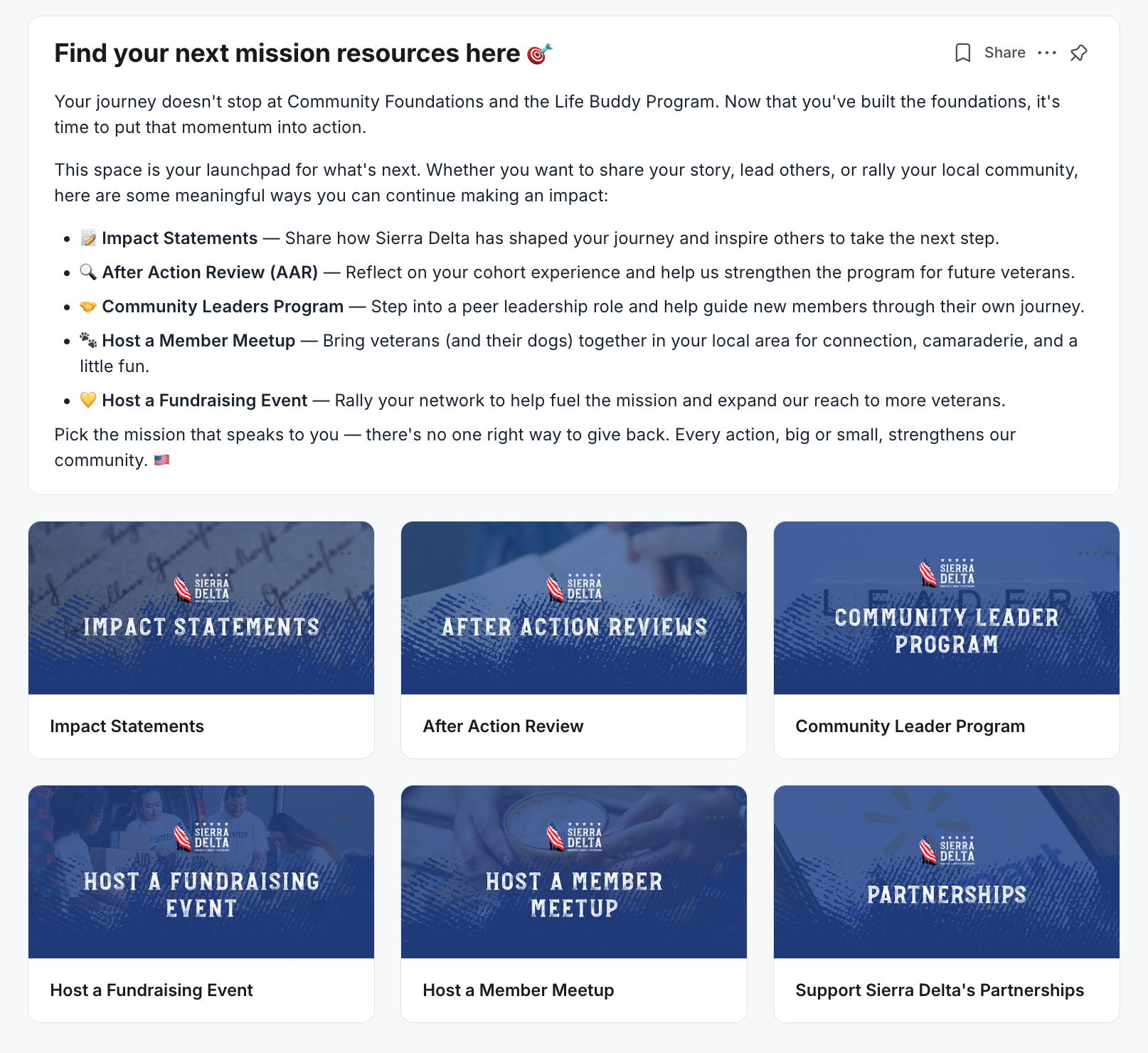
3. What’s Next: Designing a Long-Term Leadership Journey
Alongside daily operations and leadership development, we’ve also worked closely with Sierra Delta to design a long-term vision for sustainable community growth.
Together, we developed a three-year member journey framework designed to support the organization’s long-term vision of expanding into local chapters nationwide.
This included mapping leadership pathways, engagement systems, programs, and community experiences that could continue growing alongside the organization itself.
Rather than creating isolated volunteer opportunities, the focus was on building an ecosystem where members could deepen their involvement over time, gradually growing into leadership, mentorship, and community roles.
What Changed
Over the course of our 18-month partnership:
More than 1,000 new members joined the Sierra Delta community
Community participation doubled year-over-year
29 community leaders were onboarded nationwide
More than 100 virtual events were supported
Leadership and support became increasingly distributed across the network
Members reported feeling more informed, connected, and supported
Veterans increasingly began helping one another directly, reducing reliance on centralized staff support as the organization grew
Fundraising started to shift from exclusively large donors to smaller member-hosted events and initiatives
Operational stability and internal trust were restore
The founder reduced day-to-day operational involvement from 40+ hours per week to roughly 2 hours per week, creating more space for partnerships, fundraising, and long-term vision work
A Partnership Built for Sustainable Growth
This transformation wasn’t the result of a one-time strategy engagement or operational overhaul.
It came from steady collaboration, thoughtful iteration, and a deep belief that strong communities grow through people, not just systems.
By combining operational support with leadership development and community strategy, Friendly Nooks helped Sierra Delta build a stronger, more connected foundation for long-term growth, one where members increasingly became active participants in shaping the future of the organization together.